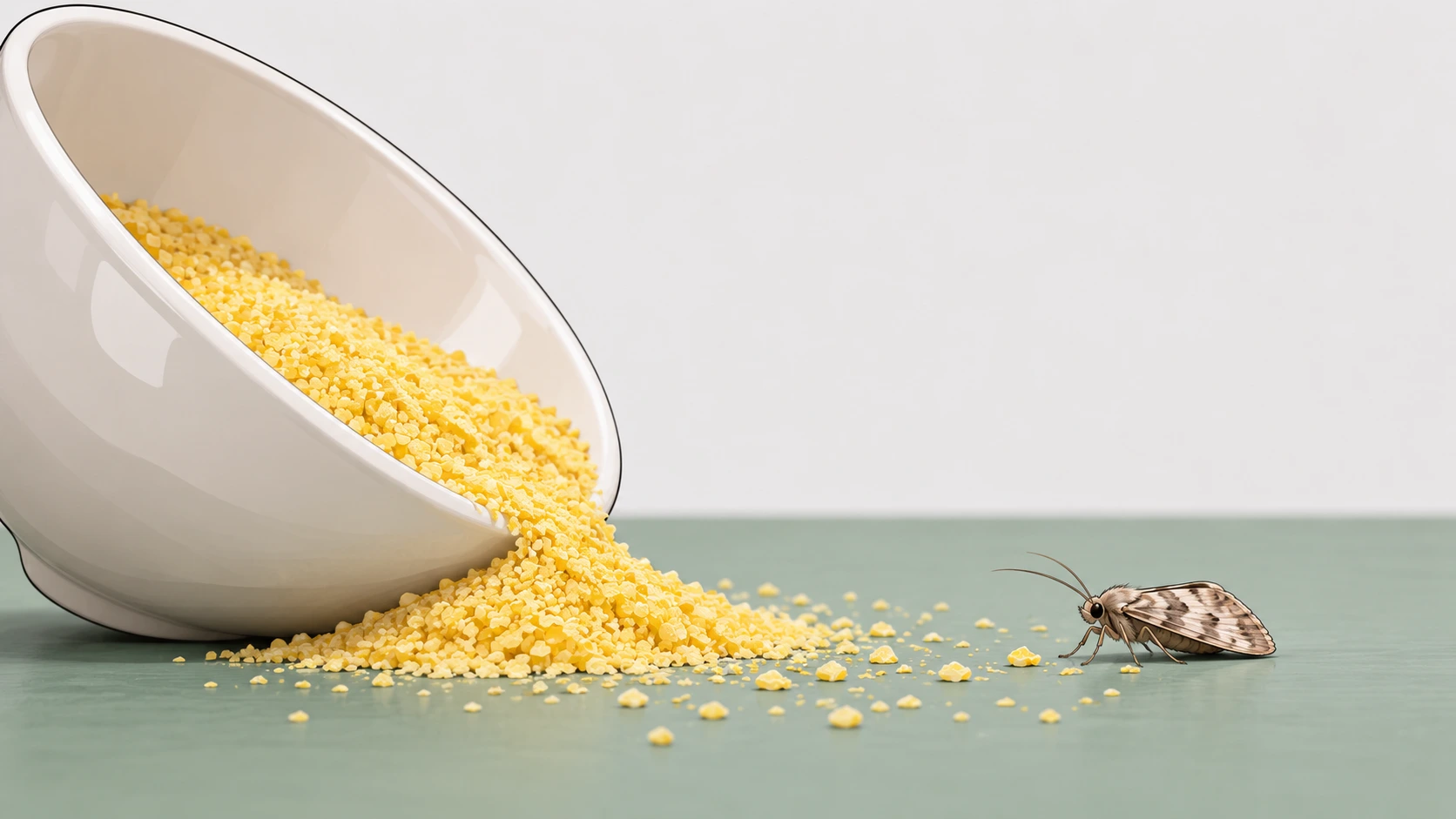
Indian meal moths got their name from “Indian meal,” an old American term for cornmeal made from maize. The moth’s caterpillars were found feeding in this ground grain, and the food association became part of the insect’s common name during the nineteenth century.
Despite the word Indian, the name does not mean the insect came from India. In this historical context, the term referred to maize, also called Indian corn, a crop associated with the Americas.
The name can be misleading today because most people no longer call cornmeal Indian meal. Without that historical context, it is easy to assume the moth was named after a country. The actual explanation is rooted in older food terminology and the observations of an American entomologist.
What Did “Indian Meal” Originally Mean?
Indian meal was another name for ground maize, the grain most Americans now call cornmeal.
In earlier American English, Indian corn referred to maize, distinguishing it from other grains commonly called corn in different English-speaking regions. When maize was ground into meal, the resulting product could be called Indian meal.
The word meal describes grain that has been ground into a relatively coarse or fine food product. It does not refer to a meal in the sense of breakfast, lunch or dinner.
The historical terminology is well documented. Indian meal is defined as cornmeal, and the expression was used in American English long before the insect acquired its familiar common name.
The word Indian in this older food term reflects historical European terminology associated with Indigenous peoples of the Americas. Maize was cultivated in the Americas long before Europeans arrived, and the crop became an important part of North American food production.
That historical usage explains the moth’s name, although the terminology itself is dated.
Today, a bag labeled cornmeal is far more familiar than one labeled Indian meal. The insect’s common name survived even as the older food term largely disappeared from everyday speech.
How Did Indian Meal Become Part of the Moth’s Name?
The connection came from the insect’s feeding activity.
Indian meal moth larvae can develop in stored grain products, including cornmeal. When insects were found infesting material known as Indian meal, that food provided a convenient way to describe them.
The association became established in nineteenth-century American entomology. The historical explanation of the Indian meal moth’s common name specifically links it to the period when cornmeal was called Indian meal.
The name therefore preserves an observation about the material in which the moth’s larvae were found. It does not describe an unusual color pattern, a specific geographic range or a relationship to India.
This type of naming was practical for people dealing with insects in stored agricultural products. A familiar commodity could provide a recognizable label for a pest before its scientific name became widely known outside entomology.
There is an important distinction between the historical incident that inspired a common name and every food an insect can eat. Cornmeal helped give the Indian meal moth its name, but the species is not limited to cornmeal.
The range of foods Indian meal moth larvae can infest includes many other dry stored products. That broader diet explains why the name often appears in modern discussions of pantry infestations even when no cornmeal is present.
Who Coined the Name Indian Meal Moth?
The common name is credited to Asa Fitch, a nineteenth-century entomologist who worked for the state of New York.
Fitch studied agricultural insects and described the moth in connection with larvae found feeding in cornmeal. The terminology used for that grain at the time gave rise to the name Indian meal moth.
A taxonomic identification record for Plodia interpunctella credits Fitch with coining the common name and specifically connects his observation with cornmeal.
Fitch’s work belongs to the nineteenth century, and the name is commonly associated with an 1856 report. That provides a useful historical reference point without implying that the moth was first discovered in 1856.
The insect already had a scientific description before Fitch used the American common name. Those are separate events in the history of its identification.
Common names can become popular through farming, trade, pest-control publications and everyday usage. They do not follow exactly the same formal rules as scientific names, which explains why an insect can have an established scientific identity and still acquire new common names.
For this species, the food-based term developed into the name familiar to homeowners today.
Does “Indian” Mean the Moth Comes From India?
No. India is not what the historical name refers to.
The word comes from the older expression Indian corn, meaning maize. The name Indian meal moth was based on the cornmeal in which its larvae were observed.
This distinction matters because a common name can easily be mistaken for evidence about where an animal originated.
The historical name explanation in a university entomology reference specifically states that the moth received its common name in the United States because it infested meal made from Indian corn.
That tells us why the insect was named. It does not establish its original geographic home.
A species can receive a name in one country, become associated with a particular imported product or be discovered in a specific setting without having originated there.
Likewise, a species may be described scientifically in one region even when its earlier evolutionary and geographic history is uncertain.
The geographic origin and present distribution of Indian meal moths require a separate examination of historical records and biological evidence. The common name should not be used as a shortcut for answering that question.
Does the Name Mean Indian Meal Moths Are Native to America?
The cornmeal explanation does not prove that either.
The word Indian refers to a historically American food term, and the common name was associated with observations made in the United States. Neither fact establishes where the moth originally evolved.
This is a useful distinction because the two mistaken assumptions point in opposite directions. Some readers infer an Indian origin from the country name. Others learn that Indian meal meant American cornmeal and conclude the moth must therefore be native to North America.
Both conclusions go beyond what the naming evidence establishes.
The history of a species’ common name is not the same as the history of its natural distribution. A name may record the food an insect damaged, the person who described it or the place where someone first paid attention to it.
To determine native status, researchers need evidence about historical distribution and the species’ relationship to populations elsewhere.
The question of whether Indian meal moths are considered invasive also cannot be settled from their common name alone. That classification requires geographic context rather than an interpretation of the word Indian.
For this article, the supported historical conclusion is narrower: the name arose from a cornmeal association, not from a demonstrated native range.
Why Is the Word “Indian” Still Used Today?
Common insect names often survive long after the everyday words behind them have fallen out of use.
Indian meal moth became established in agricultural, entomological and pest-control writing. Once a name is widely recognized, it can remain useful as a consistent label even when its original meaning needs explanation.
The scientific name of the species is Plodia interpunctella, but people commonly encounter the English name in household identification materials and pest-management instructions.
Both spellings Indian meal moth and Indianmeal moth appear in authoritative references. The hyphenated form Indian-meal moth can also be found.
These differences in spacing do not indicate different species.
The accepted identification of the Indian meal moth is the same regardless of which common-name spelling is used.
The name has remained recognizable because the insect is a well-known stored-product pest, particularly in places where dry foods and animal feed are kept.
Its continued use also illustrates a broader feature of common names: they often preserve historical language rather than being updated each time everyday vocabulary changes.
Why Isn’t It Simply Called the Cornmeal Moth?
Cornmeal moth would describe the historical feeding association clearly, but Indian meal moth is the name that became established.
There is no requirement that a common name describe the full range of foods an insect consumes. In fact, such a requirement would make many familiar pest names misleading.
Indian meal moth larvae can develop in cereal products, nuts, dried fruit, seeds and other stored materials. They are not restricted to maize-based products.
The original food association remains historically accurate without defining the entire diet of the species.
For example, a homeowner may find Indian meal moths in birdseed or dry pet food without having any cornmeal in the house. The insects have not changed species because the infested material differs from the one that inspired their name.
That distinction is especially helpful when readers encounter the moth’s name while tracing how Indian meal moths entered their home. The correct investigation follows actual infested materials rather than focusing on cornmeal alone.
The name tells a historical story. Identifying the present infestation requires evidence from the food or other suitable material where larvae are developing.
Is Indian Meal Moth One Word or Three?
You will encounter several written forms:
Indian meal moth
Indianmeal moth
Indian-meal moth
All three refer to the same insect when used for Plodia interpunctella.
The joined form, Indianmeal moth, is common in North American entomological literature. The separated form, Indian meal moth, is equally recognizable in homeowner-oriented writing.
These spelling variations have no bearing on whether the insect is native to a particular country or what its larvae consume.
The broader term pantry moth may also be used for this species, but it can refer more loosely to other stored-food moths. The difference between pantry moth and Indian meal moth terminology helps distinguish a specific common name from a general household label.
When precision matters, the scientific name provides a consistent identification. The scientific name of the Indian meal moth is Plodia interpunctella.
For ordinary writing, Indian meal moth is a clear and familiar choice.
What the Name Tells You, and What It Doesn’t
The meaning becomes clearer when the historical and biological questions are separated.
| Question | What the name supports |
|---|---|
| Why is it called an Indian meal moth? | Its larvae were associated with cornmeal historically called Indian meal |
| What did Indian meal mean? | Ground maize, or cornmeal |
| Who is credited with the common name? | Nineteenth-century New York entomologist Asa Fitch |
| Does Indian refer to the country of India? | No, it comes from the older American food term |
| Does the name establish where the moth is native? | No |
| Must an infestation involve cornmeal? | No |
| Are Indianmeal moth and Indian meal moth different insects? | No, they are spelling variants |
The distinction between a name’s historical meaning and the evidence needed to identify an insect is worth keeping in mind. A common name may preserve an accurate observation about one food source while telling us very little about geographic origin.
The Bottom Line
Indian meal moths are named after Indian meal, an old term for cornmeal made from maize. The common name became established in nineteenth-century American entomology and is associated with Asa Fitch’s observations of moth larvae feeding in that product.
The word Indian reflects historical terminology for maize in the Americas. It does not mean the moth was named because it came from India, and it does not prove the species originated in North America either.
The name is a surviving piece of agricultural vocabulary. Understanding that history resolves the geographic misunderstanding without changing the insect’s identity as Plodia interpunctella.
One thought on “Why Are They Called Indian Meal Moths?”